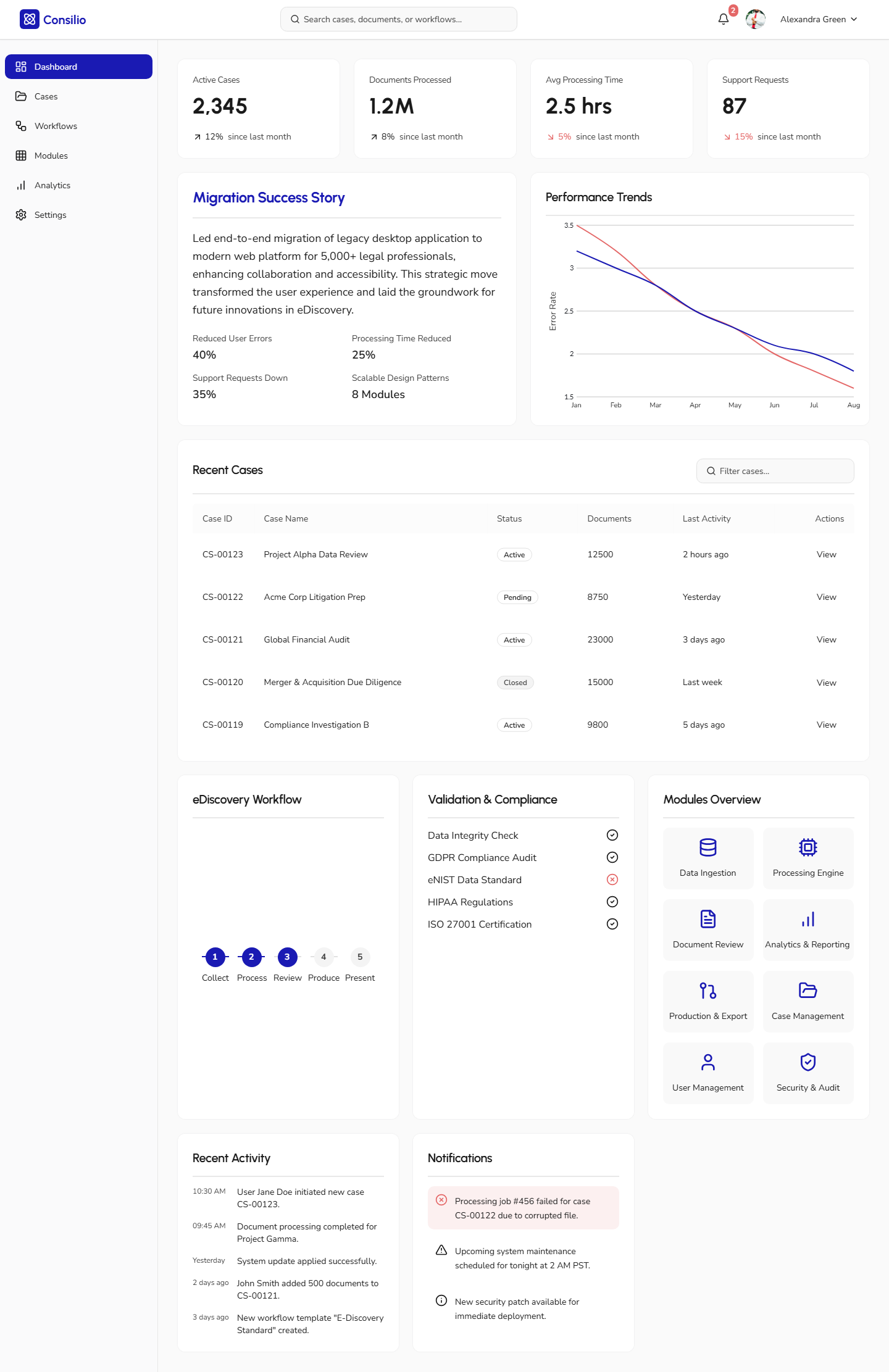
Led UX design for migrating a 15-year-old desktop application to modern web platform. Created scalable design patterns used across 8 different modules serving Fortune 500 financial institutions.
Context
Consilio provides eDiscovery software to legal teams at Fortune 500 companies handling complex litigation. Their flagship product was a 15-year-old desktop application with a massive feature set but an increasingly dated interface.
Legal professionals were struggling with productivity as the industry moved toward remote work and multi-device access. The business needed a complete platform migration without losing any critical functionality.
Key Problem Statement: How might we modernize a complex 15-year-old desktop application for the web while maintaining feature parity and reducing the steep learning curve?
Discovery
I spent the first 3 months deeply understanding the existing system—its 200+ features, user workflows, and the mental models that legal professionals had built over years of use.
eDiscovery Workflow
The EDRM framework guiding eDiscovery workflows across 8 modules
Documented all 200+ features and their usage frequency from analytics.
Observed legal professionals using the desktop app in real litigation projects.
Identified 47 usability issues causing errors and slowdowns.
Worked with engineering to understand web platform limitations.
Solution
❌ Before
87 buttons visible at once, requiring memorization of icon meanings
✓ After
Actions appear based on selection, reducing visible options by 70%
❌ Before
12-step workflows requiring constant dialog dismissal
✓ After
Direct manipulation with inline editing and auto-save
❌ Before
12px fonts and 16px icons designed for 1024x768 screens
✓ After
Scalable UI adapting to screen size with 44px touch targets
I created a comprehensive design system that could be used across all 8 modules, ensuring consistency while allowing for module-specific customization.
Design System Architecture
Atomic design system serving 8 modules with 200+ components
Results
Reflection